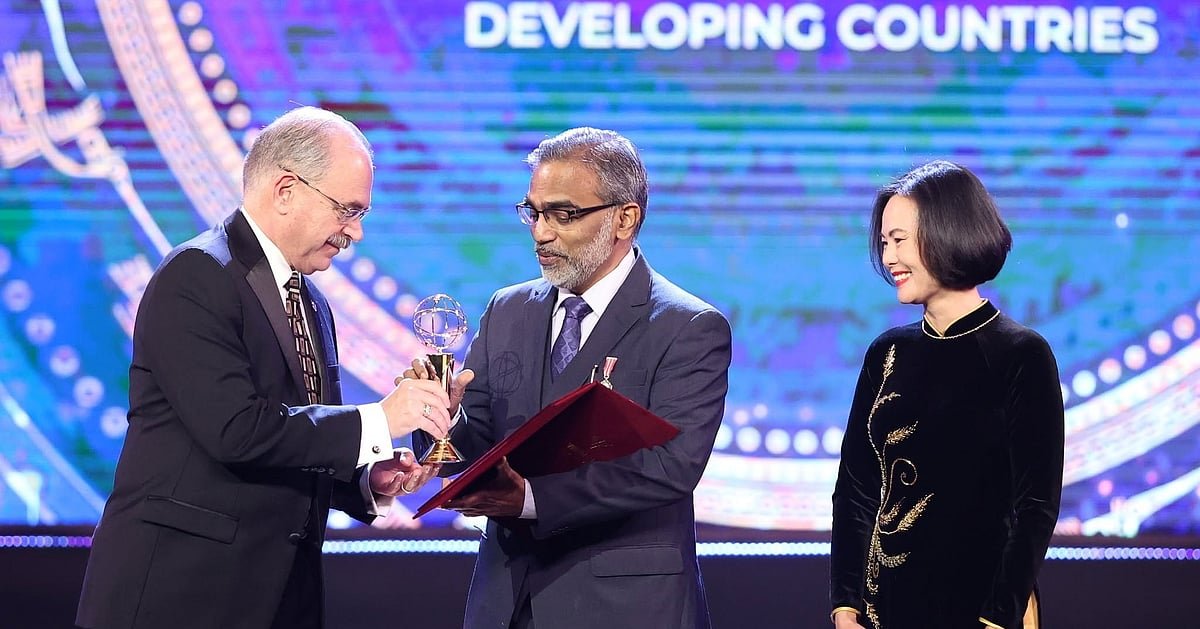
9. Many groundbreaking innovations from developing countries remain underrecognized on the global stage. How can international prizes such as VinFuture help ensure that impactful work receives the visibility, support, and recognition it deserves?
Prof. Thalappil Pradeep:
Recognition, of course, creates visibility. Visibility attracts greater collaborations and greater resources. It’s a cycle.
That recognition has to happen early so that those who get recognized, and those societies which participate, all have a longer runway for more and more innovations.
International prizes, of course, democratize recognition.
If you are recognizing early, recognizing the young, and recognizing people irrespective of regions, you are democratizing recognition.
To me, this is the way forward for international prizes — how they can make a greater impact.
Today, India is recognized with one Prize. There are many in India, of course. But there are many outside India.
Recognition has to travel across regions.
For that to happen, the recognition, the knowledge about recognition, the news about recognition, and the methodology used in identifying recognition — all of these have to reach across the world.
These require greater communication across societies.
I would say that all of these together help international prizes make an impact.
Having a Prize by itself will not change the world. We must recognize that the news about the Prize reaches everywhere. Everyone should be in a position to compete.
Every voice is seen. Every voice is heard. Every voice gets deserving attention.
It’s a very involved job. This has to happen, in my view, for years together to create meaningful impact.
IV. BUILDING A STRONGER GLOBAL SOUTH SCIENTIFIC COMMUNITY
10. One of VinFuture’s unique strengths is its ability to connect scientists, innovators, and institutions across borders. How do you envision the Prize contributing to stronger scientific collaboration among developing countries in the years ahead?
Prof. Thalappil Pradeep:
Looking at me, water is a problem which has no borders. Developing societies have several common problems of that kind.
Collaboration is the only way to address those problems.
The VinFuture Prize, therefore, is a bridge connecting scientists across borders and problems.
Once this recognition is there, then with VinFuture’s visibility, strengthening collaborations to address those grand challenges becomes natural. Collaborations become natural.
I would say that this is the way forward to address problems of the planet.
Shared problems create shared responsibilities.
If there is a mechanism to support those problems being researched upon, opportunities to support research on shared problems, we will have a better world.
Let me put this in one word: opportunities to address shared problems will be the way forward for us to build a better planet.
11. India and Vietnam are both emerging centers of innovation with growing scientific capabilities. What opportunities do you see for deeper collaboration between researchers, universities, and innovation ecosystems in our two countries?
Prof. Thalappil Pradeep:
Look at the strengths. The strengths of these two countries, first and foremost, are young talent. Secondly, strong universities.
Both are recognizing knowledge as the transformative power of these societies. And both have very strong innovation ecosystems. We both have developmental priorities.
So if you look at it from that framework, what should we address?
We should be addressing our common problems: water technologies, circular economy, rare earths, sustainable agriculture, green construction, sensors, green energy, urban mining, circularity, sustainable Vietnam, circular Vietnam — all of these are similar problems.
Circular India and circular Vietnam are similar problems.
So I would say India and Vietnam are not merely emerging economies; they are emerging knowledge societies.
They will address their problems with their young talent if we are in a position to motivate them properly.
So the problems are similar, the aspirations are similar, and that is our greatest strength between these two societies.
12. Looking ahead, are there specific initiatives, partnerships, or networks that you would like to champion through your role on the VinFuture Prize Council to strengthen South-South scientific cooperation and foster greater collaboration between developing countries and Vietnam?
Prof. Thalappil Pradeep:
Science has always been humanity’s most powerful common language, and both our societies will address our challenges.
The world as a whole will address those challenges only through science. Science has no borders, and it is beyond races and all that.
What are those grand challenges that VinFuture can address?
I work in the area of materials, water, and such things. To me, if I were to put one large problem that we can address, it is what I said previously as circular Vietnam.
But circular Vietnam is circular India, circular world.
Can we address this?
Now, this has many, many sub-dimensions. All of these translate to energy, water, climate, and all those things.
To me, today, everyone has a role to play in this, and there is enough possibility for translation, technology development, incubation, and all of these.
So if you were to ask me one grand challenge that VinFuture can address, it is circular society.
For me and you living in these countries with lots of aspirations, we are changing nature tremendously.
Is there a way that what you do is sustainable?
That’s a question not only for me or humans, but it is from the One Health perspective. Every being has its own right to be living here.
So this is something that we in the developing world can demonstrate to the world.
I would say, hats off to VinFuture’s founders.
Recognition that science, when it impacts society, needs to be recognized. It’s a thought that is coming from the developing world, and with a Prize of this kind, hats off to them.
And if that vision can be translated to discovering new solutions, finding new solutions which impact society, that is an even greater vision.
You recognize those discoveries — that is one thing. But you also support the creation of new solutions which will eventually transform the world — that is an even greater ambition and a greater aspiration.